Custom RX-8 Sohn Adapter and Separate OMP Oil Supply
The custom front-cover adapter, separate reservoir oil path, priming, checks and Bio-Rotary premix doses.
This adapter retains the factory Series 1 electronic OMP and its four metering pipes/nozzles. It changes only the pump inlet: instead of drawing engine oil through the front cover, the OMP draws clean two-stroke oil from a dedicated reservoir.
Oil paths
| Arrangement | Path |
|---|---|
| Factory | Engine sump → front-cover drilling → factory OMP → four pipes/nozzles → engine |
| Modified | Separate vented reservoir → oil-resistant supply hose → custom front-cover adapter → factory OMP → four pipes/nozzles → engine |
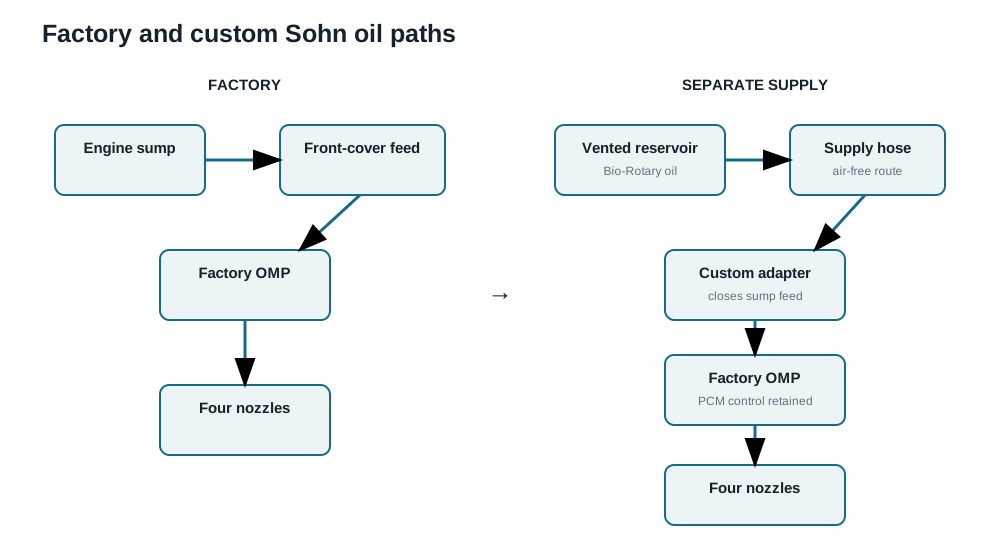
The machined/printed interface sits between the Series 1 front cover and OMP, closes the original sump-oil feed and presents a separate inlet to the pump. The OMP remains in its factory location with its drive and electrical control unchanged.
Component record
| Field | Record |
|---|---|
| Adapter material | __ |
| Front-cover/OMP seal type | __ |
| Interface and port dimensions | __ |
| Reservoir capacity | __ |
| Pump and control | Factory Series 1 electronic OMP and PCM strategy |
| Delivery | Four factory metering pipes and nozzles |
| Oil | Renewable Lubricants Bio-Rotary Racing Premix |
Add dimensioned CAD and a section render here when the build files are ready. The useful drawing must show the original front-cover feed closure, new inlet, pump drive clearance, sealing faces and fitting engagement rather than a decorative outside view.
Installation and hose routing
- Work cleanly and cap the open front-cover and pump ports immediately. Remove the OMP without pulling it sideways against its drive.
- Inspect both interface faces and the pump drive. Fit the specified adapter seals in their intended grooves; do not use fasteners to pull a misaligned drive into place.
- Mount the OMP squarely on the adapter and confirm the drive turns/seats as designed before tightening.
- Mount the vented reservoir upright where its level can be checked, away from exhaust heat and moving belts. It must remain able to feed under braking and cornering.
- Route the supply continuously downhill where practical, without high loops that trap air. Use oil-compatible hose and positively retained fittings; protect it at every edge and hot zone.
- Keep the hose visible enough to inspect for bubbles. Avoid cable ties that flatten the bore and fittings that impose a tight bend at the adapter.
Priming and leak checks
- Fill the reservoir and open/loosen the lowest appropriate connection until bubble-free oil reaches the adapter, then secure it.
- Prime the OMP inlet and metering circuit by the applicable Mazda/Sohn method. Do not rely on the pump to purge a long dry hose during a running first start.
- Confirm all four metering lines are connected to their labelled nozzles and that the nozzles hold vacuum in the factory test direction.
- With fuel and ignition disabled, crank in short intervals and watch the feed for persistent bubbles or loss of column.
- Start only after engine oil pressure and the separate OMP supply are established. Inspect the reservoir, hose, adapter, OMP and four lines cold, hot and after the first drive.
- Mark the reservoir level and log distance, fuel added and oil used. A repeatable level fall is the practical whole-system delivery check; an unexpectedly unchanged or rapidly falling level needs investigation.
Likely failure modes are an empty or unvented reservoir, loose fitting, air leak, heat/chafe damage, incompatible hose, failed interface seal, mis-seated drive, blocked line/nozzle or lost prime. There is no factory low-level warning for the separate tank.
Bio-Rotary oil and premix
Bio-Rotary Racing Premix is used in the separate reservoir and can also be dosed into the fuel. Premix supplements the targeted OMP delivery; it does not repair a failed pump or blocked nozzle.
For a naturally aspirated petrol daily driver, the published range converts as follows:
| Petrol added | 1.95 mL/L (about 512:1) | 3.91 mL/L (about 256:1) |
|---|---|---|
| 10 L | 20 mL | 39 mL |
| 20 L | 39 mL | 78 mL |
| 30 L | 59 mL | 117 mL |
| 40 L | 78 mL | 156 mL |
| 50 L | 98 mL | 196 mL |
The source range is 0.25–0.50 US fl oz per US gallon. Calculate from the actual litres dispensed; do not confuse US and imperial gallons or assume more oil is always better.